
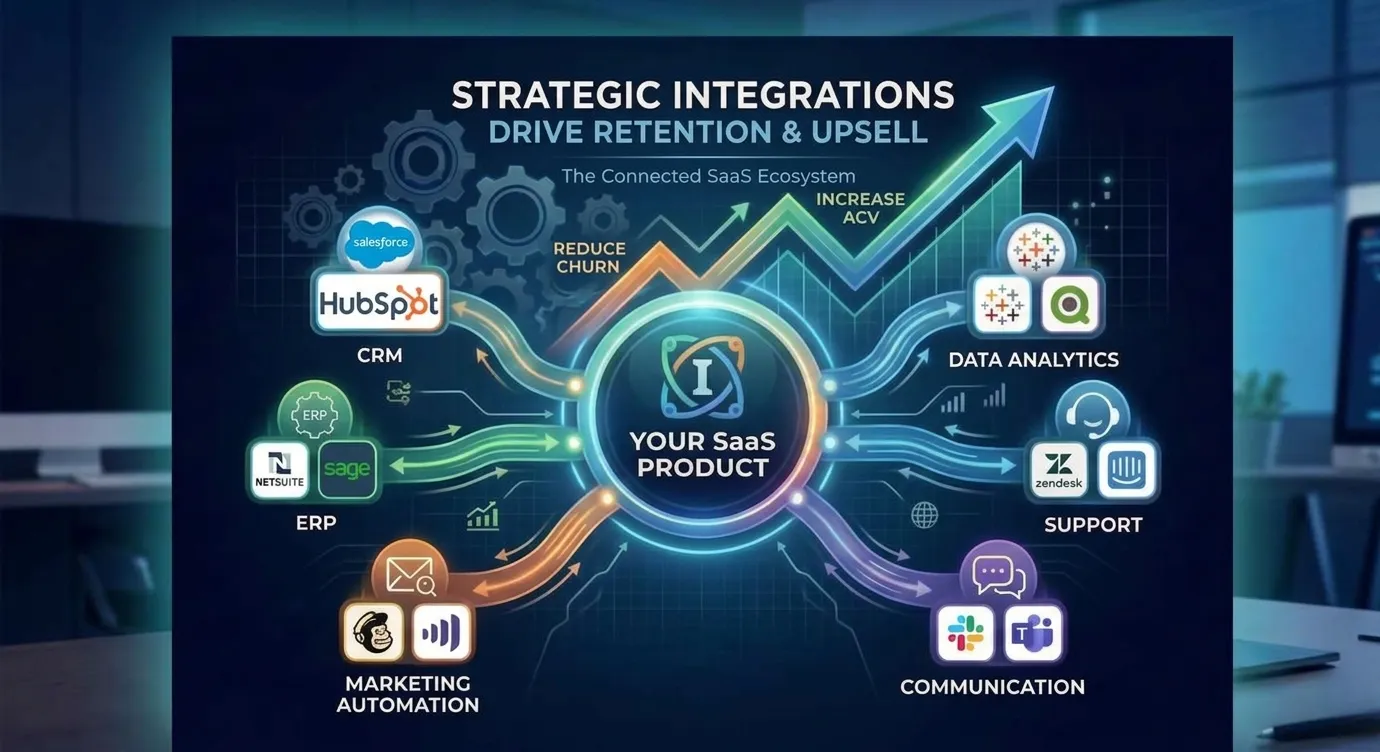
Most SaaS companies treat integrations as feature requests. The smartest ones treat them as revenue infrastructure.
And the difference between those two mindsets? It’s the difference between companies that struggle with churn and companies that scale predictably.
Here’s the reality of where we are in 2025: the average business runs on 130+ SaaS tools. Sales teams live in their CRM. Finance lives in their ERP. Marketing runs across three or four automation platforms. Data teams have their own stack entirely. Nobody is running their business on a single tool — and nobody ever will again.
This means your product doesn’t exist in isolation. It exists inside a web of other tools, workflows, and data systems. And if it doesn’t connect to that web? Customers will find a product that does.
Integrations are no longer a competitive advantage. They’re the baseline expectation. The question isn’t whether you need them — it’s whether you’re using them strategically enough to protect and grow your revenue.
Let’s talk about how.
Why Integrations Matter More Than Ever Right Now
We’re at an inflection point in how businesses buy and use software.
A decade ago, a product could win on features alone. If you had the best functionality, customers would adapt their workflows to fit your product. That era is over. Today’s buyers evaluate software by asking a different question first: Does this fit into how we already work?
Integration capability has become one of the top three factors in software purchasing decisions. Businesses aren’t just buying your product — they’re buying how well your product plays with everything else they’ve already invested in.
And the impact is showing up in the numbers. Companies that prioritize integration ecosystems are seeing:
- Faster time-to-value for new customers, because integrations eliminate the manual setup and data migration that used to slow adoption
- Higher net revenue retention, because connected customers have more reasons to stay and fewer reasons to leave
- Shorter sales cycles, because enterprise buyers who see native integrations with their existing stack feel significantly less risk in buying
The businesses that understood this early built integration-first product strategies. The ones still treating integrations as an afterthought are watching their churn numbers tell the story.
Integrations Are Your Single Strongest Retention Tool
They Make Leaving Genuinely Painful
Think about what happens the moment a customer connects your product to their CRM, accounting system, ERP, or marketing automation platform.
Your product stops being a standalone tool. It becomes part of how their business actually runs. Their data flows through it. Their team relies on it. Workflows depend on it. If they wanted to switch to a competitor, they wouldn’t just be changing software — they’d be dismantling operational infrastructure.
A standalone product is replaceable. A deeply integrated product becomes part of the business itself.
This is the switching cost argument, and it’s the most powerful retention mechanism available to any SaaS company. Every integration you add is another thread tying your product to your customer’s business. The more threads, the higher the cost of cutting them — and the lower your churn.
This is why the companies obsessing over integrations right now aren’t doing it just to check a feature box. They’re doing it because they understand that integration depth is a direct measure of how embedded they are in their customers’ operations. And embedded products don’t churn.
They Turn Casual Users Into Power Users
There’s a well-established relationship between product usage frequency and retention. Customers who log in daily churn far less than customers who log in weekly. And customers who log in weekly churn far less than those who only show up occasionally.
Integrations fundamentally change usage patterns — in your favor.
When your product is integrated with the tools a customer uses every day, it gets pulled into daily workflows automatically. They’re not coming back because they remember to. They’re coming back because the workflow requires it. That’s a fundamentally different kind of engagement — and it’s far stickier.
Here’s how integrations drive usage:
- Automated data sync eliminates the manual effort that used to interrupt workflows. When data moves automatically, customers interact with your product without friction — and they do it more often.
- Cross-platform automation gives customers a reason to see value from your product across every system they use, not just inside your interface.
- Unified visibility makes your product the place where everything comes together — the hub, not just another spoke.
The business impact of this is measurable. Companies consistently find that integrated customers engage more deeply, derive more value, and churn at dramatically lower rates than non-integrated customers.
A simple framework to track this:
| Metric | What It Tells You |
| Integration adoption rate | What % of your customer base has activated at least one integration |
| Engagement: integrated vs. non-integrated | Whether integrations actually drive deeper usage |
| Churn rate: integrated vs. non-integrated | The retention value of integrations in hard numbers |
| Time-to-first-integration | How quickly new customers get connected — a leading indicator of long-term retention |
If your integrated customers churn less — and in virtually every SaaS company that measures this, they do — you have your business case. Integrations aren’t a cost center. They’re a retention engine.
Integrations Are Quietly Driving Expansion Revenue
They Create Natural Upgrade Paths
Look at how the most successful SaaS companies structure their pricing tiers. Entry-level plans give you the core product. The mid-tier adds more depth. Enterprise plans? That’s where the integrations unlock.
This isn’t arbitrary. It’s a deliberate growth strategy — and it works because integrations justify price increases in a way that raw feature additions often don’t.
When a customer outgrows their current plan and needs to connect your product to their ERP or enterprise data warehouse, they have a concrete, functional reason to upgrade. It’s not a vague promise of “more features” — it’s a specific capability they need to do their job. That’s a much easier upsell conversation.
The broader impact here is significant:
- Integrations increase perceived product maturity. A product with a deep integration ecosystem looks like an enterprise-grade solution. That perception alone justifies a higher price point.
- They make enterprise sales dramatically easier. Large organizations have standard tech stacks. If your product natively integrates with the tools they already use, you’ve removed one of the biggest objections in the sales process.
- They signal that you’re in this for the long term. A company that’s built and maintained integrations across dozens of platforms is a company that enterprise buyers can trust with mission-critical workflows.
They Tell You Exactly Who’s Ready to Buy More
Here’s the part that most SaaS companies underutilize: integrations are a window into your customers’ operations. And that visibility is incredibly valuable for your sales and customer success teams.
When customers integrate your product with their other systems, you start to see things you couldn’t see before:
- Data volume trends. A customer whose data volume is growing fast is a business that’s scaling — and a business that’s scaling is often ready to talk about a higher-tier plan.
- Workflow complexity. When you see a customer building sophisticated multi-system automations, that’s a sign they’re deeply invested in your product. They’re not going anywhere — and they might be ready to go deeper.
- Usage spikes. A sudden spike in API calls or data syncing is often a leading indicator of growth. It’s also a natural trigger for a customer success conversation.
Integrations don’t just connect systems — they expose expansion opportunities.
Every integration touchpoint is a signal. The companies winning at expansion revenue have learned to read those signals and act on them before a competitor does.
The Real Business Impact: What Integration-First Companies Are Seeing
Let’s make this concrete. The companies that have leaned hardest into integration strategy are seeing compounding benefits across their entire business:
Lower Churn, Higher LTV. When products are embedded in customer workflows, churn becomes the exception rather than the rule. Customers who integrate deeply tend to stay for years, not months — and that extended tenure has an exponential impact on lifetime value.
Accelerated Expansion Revenue. Integrations create natural upsell moments without heavy-handed sales tactics. The customer reaches the limit of their current plan organically, the upgrade conversation happens in context, and the conversion rate is significantly higher than cold upsell attempts.
Stronger Word-of-Mouth. Deeply integrated products get recommended more often. When a tool is genuinely embedded in how a team works, people talk about it. They bring it with them when they change jobs. They recommend it to peers in their network. Integration depth drives advocacy in a way that pure feature lists don’t.
A More Defensible Market Position. Integration ecosystems are hard to replicate quickly. Once you’ve built and maintained relationships with dozens of integration partners, established API documentation, and earned the trust of enterprise buyers, that becomes a real competitive moat. A new entrant with a similar feature set can’t replicate your integration ecosystem overnight.
An Integration ROI Framework You Can Actually Use
Before making any integration investment, it’s worth running the numbers. Here’s a formula you can bring to your next planning conversation:
Integration Revenue Impact Formula:
(Retention Lift × Customer Lifetime Value)
+ (Upsell Conversion Rate × ARPU Increase)
− (Integration Development & Maintenance Cost)
= Integration ROI
How to apply it:
- Retention Lift — Compare churn rates between integrated and non-integrated customers. A 5–10% difference in churn rate is common, and at scale, that’s enormous.
- Customer Lifetime Value — Your average LTV. Even small improvements in retention compound dramatically over time.
- Upsell Conversion Rate — What percentage of customers who activate a premium integration eventually upgrade their plan?
- ARPU Increase — How much more do upgraded customers pay on average?
- Development & Maintenance Cost — The full lifecycle cost of the integration, not just the initial build. Maintenance is ongoing and real — factor it in honestly.
This formula won’t give you a perfect prediction, but it will force the right conversation. It shifts the question from “can we afford to build this?” to “what does it cost us not to?”
The Conclusion That Changes How You Think About Integrations
We started with a simple idea: most SaaS companies treat integrations as feature requests. But by now, the picture is a lot clearer.
Integrations are retention infrastructure. They’re upsell engines. They’re competitive moats. They’re the reason some SaaS companies scale predictably while others fight churn quarter after quarter.
The businesses winning right now aren’t building integrations reactively, one customer request at a time. They’re building integration ecosystems intentionally — because they understand that every integration they ship makes their product harder to replace, more valuable to expand, and more defensible against competition.
The companies that win don’t build integrations because customers ask for them. They build integrations because they understand that integrations compound revenue over time.
And in a market where every dollar of growth is harder to earn than it used to be, that compounding effect isn’t just nice to have. It’s the strategy.
Thinking about your integration strategy? Drop a comment below — how is your team approaching integrations as a retention and growth lever?